Lloyd Archer (born March 4, 1925, in Mineola, Nassau County, New York) was a World War II veteran, skilled tool and mold maker, and local entrepreneur who later became part of the industrial and civic life of Plattsburgh, New York. At age eighteen he registered for the military draft while working at Cameo Bowling Alley in Forest Hills, New York. Archer enlisted in the U.S. Army on August 7, 1943, and served until his discharge on November 22, 1945. After the war he recalled experiencing racial discrimination in Baltimore, where he was denied the right to drink a soda inside a store because segregation laws prohibited it—an incident that starkly contrasted with his upbringing on Long Island and left a lasting impression on him.
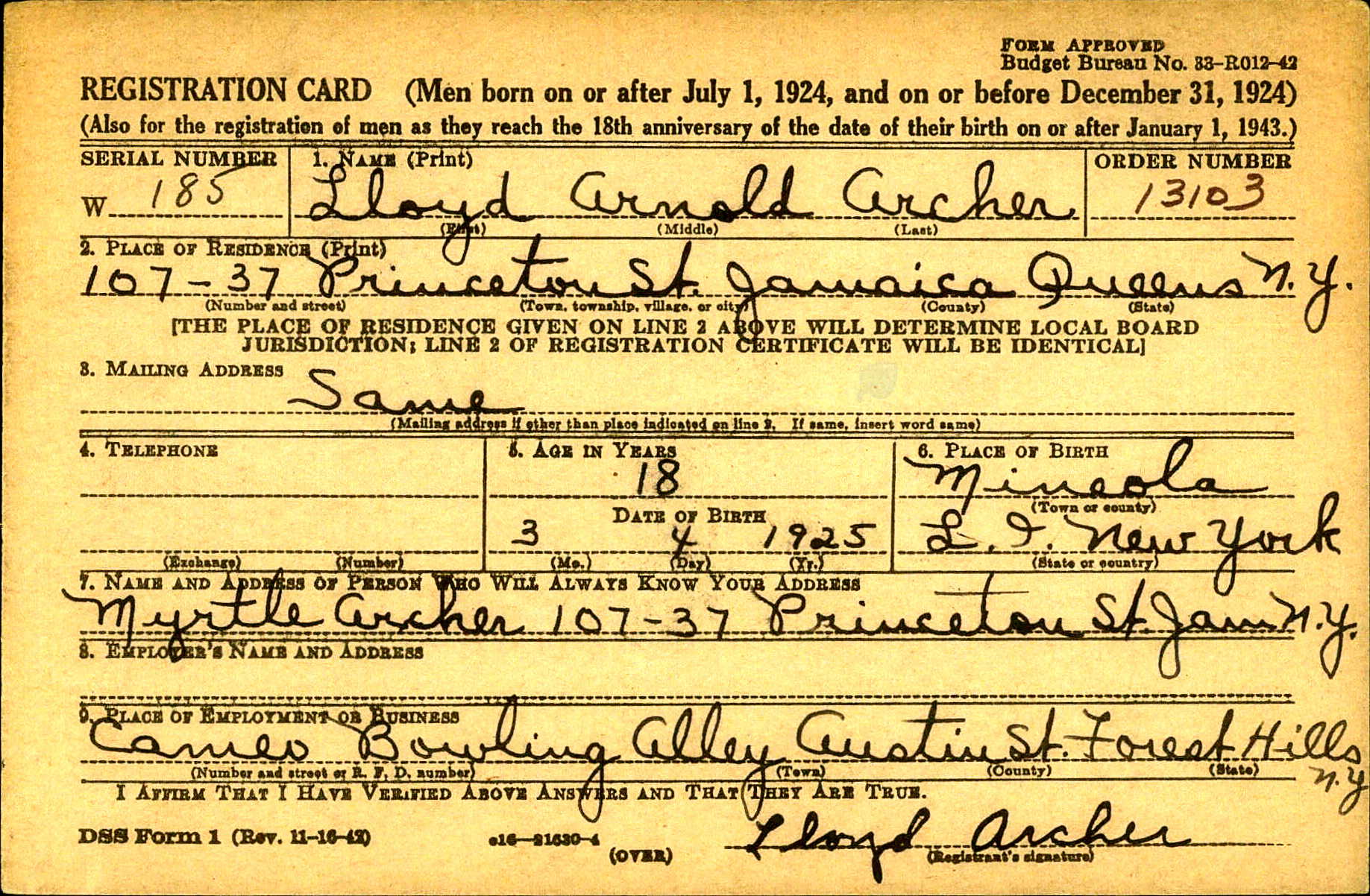
Archer later attended East New York Vocational School and in November 1955 married Jacqueline H. Creed in Roselle, New Jersey. By the mid-1960s the couple had moved to Plattsburgh, where Archer established himself as a tool and mold maker and founded the business Quick Cast Ltd. on Charlotte Street. He later expanded his industrial work by opening North Country Radiant Glass Heat, a company specializing in radiant glass heating panels. Archer’s business activity made him a recognized member of the community—evidenced by his selection as a prospective juror for the October 1966 term of Clinton County Court. In March 1979, a major fire caused significant damage to his die-casting plant, though no one was injured. Archer’s life reflects the experiences of a veteran, entrepreneur, and African American resident whose story intersects with both national struggles over civil rights and the local industrial history of the North Country.